






















Ndlozi, Mbeki and the Quiet Move: Is South Africa Watching a Political Chess Game?
By: Mhlengi Mafu
In politics, the loudest movement is not always the most important one.
Sometimes, the politician shouting from the podium is not the politician shaping the future. Sometimes, the man making headlines is merely occupying the square that allows another piece to move. And sometimes, the most significant political development is taking place in full public view precisely because the public has been trained to look elsewhere.
This is where the story of Dr Mbuyiseni Ndlozi becomes interesting.
Perhaps even suspiciously interesting.
The question is not whether Ndlozi is the next president of South Africa. It is too early, and perhaps too simplistic, to ask that question. The more important question is whether South Africa is witnessing the intellectual and political repositioning of a man who may yet become an important piece in a much larger game.
Could Ndlozi be Thabo Mbeki’s political heir?
Or, to put the question more carefully: could he be a man currently being exposed to, shaped by and perhaps prepared within a school of thought that Thabo Mbeki spent decades building?
There is no public evidence of a secret political succession plan. There is no signed document announcing that Ndlozi is being groomed to return to the ANC as a presidential project. That would be too easy. Politics at the highest level rarely announces its intentions before the conditions are ready.
But there are coincidences.
And in politics, coincidences are sometimes worth studying.
The African Renaissance Podcast, hosted by Ndlozi, has become a platform directly associated with the Thabo Mbeki Foundation. The programme is not simply another celebrity podcast. Its intellectual architecture is unmistakable: Africa, history, sovereignty, development, Pan-Africanism, state capacity, governance, colonialism, diplomacy and the unfinished project of African freedom.
The Foundation itself defines its mission around catalysing an African Renaissance and promoting progressive African solutions to continental challenges. The podcast, hosted by Ndlozi, has become an extension of that intellectual environment.
That fact alone should not produce conspiracy theories.
But it should produce questions.
The Politics of Proximity
There is an old principle in politics: proximity changes people.
A young politician who spends his years surrounded by slogans develops differently from one who spends those years in conversation with historians. A politician who is permanently consumed by election campaigns develops differently from one who is exposed to diplomats, economists, academics, former heads of state and thinkers.
Political mentorship is rarely announced.
It happens through access.
Through conversations.
Through reading.
Through correction.
Through exposure to institutions that force a person to think beyond the next rally, the next election or the next television interview.
Ndlozi’s proximity to the intellectual ecosystem surrounding Thabo Mbeki is therefore politically significant.
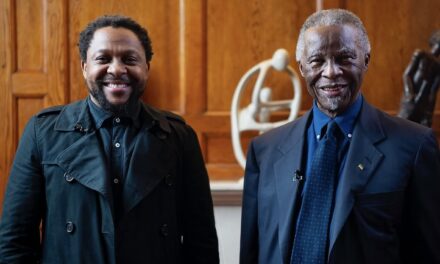
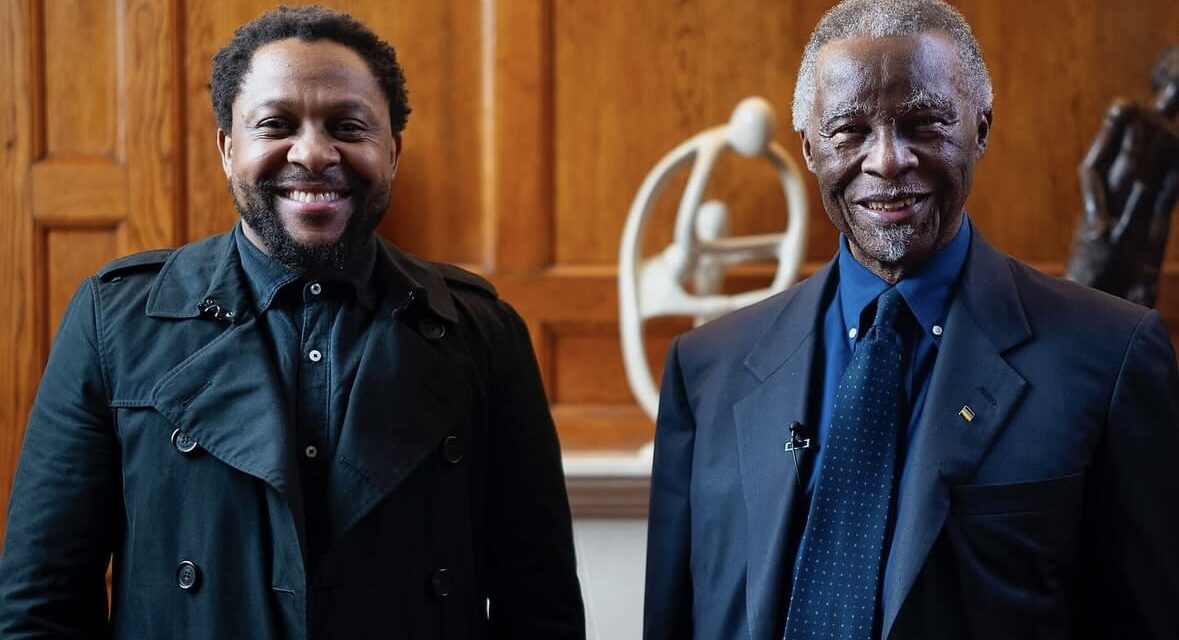
His first major African Renaissance Podcast conversation was with Mbeki himself. Their discussion ranged across Africa’s youth, leadership, constitutional democracy, the ANC’s crisis, Pan-African solidarity and the migration question. The conversation was, in many respects, an intergenerational encounter between an elder statesman and a younger political intellectual.
One could dismiss this as media work.
But one must also ask whether media is the only thing happening.
Because in politics, platforms are not neutral. A platform determines who you meet, what you read, what questions you are forced to ask and what intellectual discipline you develop.
And perhaps this is where the chessboard begins.
The Pawn That Left the Front Line
Ndlozi’s political trajectory has been unusual.
He left the immediate frontline of party politics and, instead of rushing into another political organisation, he appeared to step back. For a man of his political profile, that was remarkable.
South African politicians are not generally known for silence.
When a politician leaves a major political home, the expectation is almost always predictable: join another party, start a movement, form a faction or spend the next two years attacking former comrades.
Ndlozi did not immediately do any of these things.
He moved into broadcasting and intellectual media.
And then into the orbit of the Thabo Mbeki Foundation.
That shift matters.
A politician can lose a position.
But a politician can also use distance to change his position.
These are not the same thing.
A person who leaves the battlefield is not necessarily defeated. Sometimes, the person who steps away from the noise is simply refusing to fight on the terrain chosen by others.
In chess, not every retreat is a loss.
Sometimes the retreat opens the board.
From Revolutionary Rhetoric to Intellectual Statecraft
Perhaps the deepest connection between Ndlozi and Mbeki is not organisational.
It is philosophical.
Both men belong, in different generations, to a political tradition that takes ideas seriously.
That is not a fashionable thing to say in modern politics.
Politics has become increasingly obsessed with performance. Who trends? Who shouts the loudest? Who has the strongest social-media army? Who can create the most memorable clip?
But Mbeki emerged from an older political tradition in which the leader was expected to read history.
Ndlozi, whatever one thinks of his political choices, also comes from the world of political ideas. He is a scholar, a public intellectual and a communicator whose politics have often been framed through history, colonialism, economics and African identity.
The ideological differences between the EFF’s revolutionary politics and Mbeki’s state-centred African Renaissance project are real.
Yet there are also interesting points of intersection.
African dignity.
African unity.
Continental integration.
A suspicion of Western intellectual domination.
A belief that Africa must think for itself.
The argument that African problems cannot permanently be solved through borrowed ideas.
And perhaps most importantly, the belief that politics is not merely about managing a country. It is about constructing a historical project.
Ndlozi’s public conversations on Africa increasingly occupy this territory. The African Renaissance Podcast has hosted discussions ranging from African development and decolonisation to state capacity, Pan-Africanism, diplomacy, migration and the future of South Africa.
This is where the coincidence becomes intellectually interesting.
Because Mbeki’s greatest political contribution was not simply a presidency.
It was a vocabulary.
African Renaissance.
A generation after Mbeki placed that idea at the centre of his political imagination, Ndlozi is now one of the most prominent younger public figures hosting a platform built around precisely that intellectual tradition.
That may be coincidence.
But politics has always been the study of patterns.
The Problem With Looking for Presidents
South Africans are perhaps asking the wrong question.
Every time a politician rises, we immediately ask: Will he be president?
But political power does not always begin with a presidential campaign.
Before a man becomes a presidential candidate, he must first become politically imaginable.
Before he becomes politically imaginable, he must acquire intellectual legitimacy.
Before intellectual legitimacy, he needs a constituency.
Before a constituency, he needs a language that people can identify as his own.
Perhaps Ndlozi is not being prepared for a position.
Perhaps he is being prepared for a historical moment.
Those are two different things.
A political movement can manufacture a candidate.
History usually produces the moment that makes the candidate necessary.
The ANC’s deeper problem may not be a shortage of politicians. It may be a shortage of intellectual renewal. It has administrators, organisers, veterans, ministers and factional leaders. But the question increasingly confronting the movement is whether it can produce a new generation capable of connecting political experience with a serious vision of South Africa and Africa.
This is where Ndlozi becomes a fascinating possibility.
Not because he is currently a presidential candidate.
But because he may be developing the qualities that make a future candidate conceivable.
The Mbeki School of Thought
The phrase Mbeki’s successor can be misunderstood.
No one can simply become another Thabo Mbeki.
Mbeki was formed by exile, liberation politics, international diplomacy and a historical moment that cannot be reproduced.
Ndlozi belongs to another generation.
But every political generation has intellectual descendants.
The real question is whether Ndlozi may be developing within what could be described as the Mbeki school of political thought.
That school places enormous emphasis on Africa as a historical civilisation rather than simply a collection of struggling states.
It believes in continental cooperation.
It treats development as a question of power, knowledge and institutions.
It takes diplomacy seriously.
It insists that Africans must become participants in shaping global affairs rather than permanent subjects of other people’s decisions.
And perhaps its most controversial belief is that African liberation is incomplete.
If Ndlozi increasingly subscribes to this intellectual framework, then his relationship with the Thabo Mbeki Foundation is not just professional.
It becomes formative.
The Foundation’s work is explicitly structured around the African Renaissance and includes programmes and institutions dedicated to education, public affairs, dialogue and continental development.
That makes Ndlozi’s presence within this environment more than a career move.
It may be an education.
And in politics, education can be a form of preparation.
The Secret Is Not Necessarily a Secret
Perhaps the biggest mistake would be to imagine a dark room filled with ANC leaders plotting Ndlozi’s return.
Politics is often more subtle than that.
The so-called secret move may not be secret at all.
It may be happening openly.
A former EFF politician is hosting a major African political and intellectual platform.
The platform is associated with Thabo Mbeki’s Foundation.
The host is being exposed to academics, diplomats, political veterans and continental thinkers.
His language is becoming increasingly continental.
His public work is moving beyond the immediate vocabulary of party politics.
Meanwhile, Mbeki remains one of the most influential intellectual figures in the broader historical tradition of the ANC.
Nothing here proves a succession plan.
But all of it creates political possibility.
And political possibility is often the first stage of political power.
A Chess Master Does Not Explain Every Move
The strongest chess player is not the person who moves the fastest.
It is the person who understands the position.
The amateur sees a piece.
The master sees the consequences of where that piece will be five moves later.
This may be the mistake South Africa is making with Ndlozi.
We are looking at where he is now.
Perhaps we should be asking where this position allows him to go.
A politician inside a political party is often trapped by that party’s internal battles. A politician outside formal party structures can sometimes rebuild himself.
He can become less predictable.
Less factional.
More difficult to define.
He can speak to people who would never attend his political rally.
He can build influence before declaring ambition.
He can study the board while others are fighting over a square.
And when the political moment changes, he can move.
That is why Ndlozi’s silence after leaving the frontline of the EFF may ultimately be more important than his speeches while he was there.
Noise attracts attention.
Silence creates mystery.
And mystery, when combined with intellectual work, can create political capital.
Is Ndlozi the Next Mbeki?
Perhaps not.
At least not in the literal sense.
But the more provocative possibility is that Ndlozi could become something politically valuable to the ANC’s future: an intellectual bridge between generations.
He understands the language of the youth.
He understands protest politics.
He has experience inside a radical political movement.
He has academic credibility.
He can communicate.
And he is increasingly operating inside an intellectual environment closely associated with one of the ANC’s most sophisticated political thinkers.
That combination should not be ignored.
Perhaps South Africa is watching a man being politically repositioned.
Perhaps he is simply pursuing intellectual work.
Perhaps he will never return to formal politics.
Perhaps the speculation is completely wrong.
But political analysis is not the art of waiting for certainty.
It is the discipline of recognising patterns before they become obvious.
And the pattern around Ndlozi is becoming increasingly difficult to ignore.
The former revolutionary spokesperson is no longer standing only on the battlefield.
He is entering the library.
He is sitting at the table.
He is asking different questions.
He is speaking to a continent.
And perhaps that is the most important move of all.
Because in chess, the piece that looks inactive may simply be waiting for the board to change.
South Africa should therefore not ask only where Dr Mbuyiseni Ndlozi is today.
It should ask:
What is he being prepared for?
Or perhaps, more dangerously:
What is he preparing himself for?
Because the most important move on the chessboard is often the one you do not understand until after it has been played







Recent Comments